

Asia’s corporate protein buyers have a critical influence on the world’s fastest-growing food systems. Sourcing decisions taken by the most influential companies will shape global outcomes on climate, nature, labour standards, animal welfare, and public health.
The Asia Protein Buyers 100 (APB100) report, Asia Research & Engagement’s (ARE) investor-backed benchmark, assesses 100 of Asia’s largest listed food retailers, manufacturers, restaurant chains, and hospitality groups. How they manage environmental, social, and governance risks across protein supply chains and respond to the growing importance of plant-based and alternative proteins will have a major impact on Asian livelihoods, health and food security.
This is the second edition of the APB100, following the inaugural 2024 benchmark. It covers companies operating across 12 Asian markets: China, Hong Kong, India, Indonesia, Japan, Malaysia, Philippines, Singapore, South Korea, Taiwan, Thailand, and Vietnam.
Key Findings
While the 2026 results show clear momentum from 2024, they also reveal that most companies remain in the early stages of credible implementation.
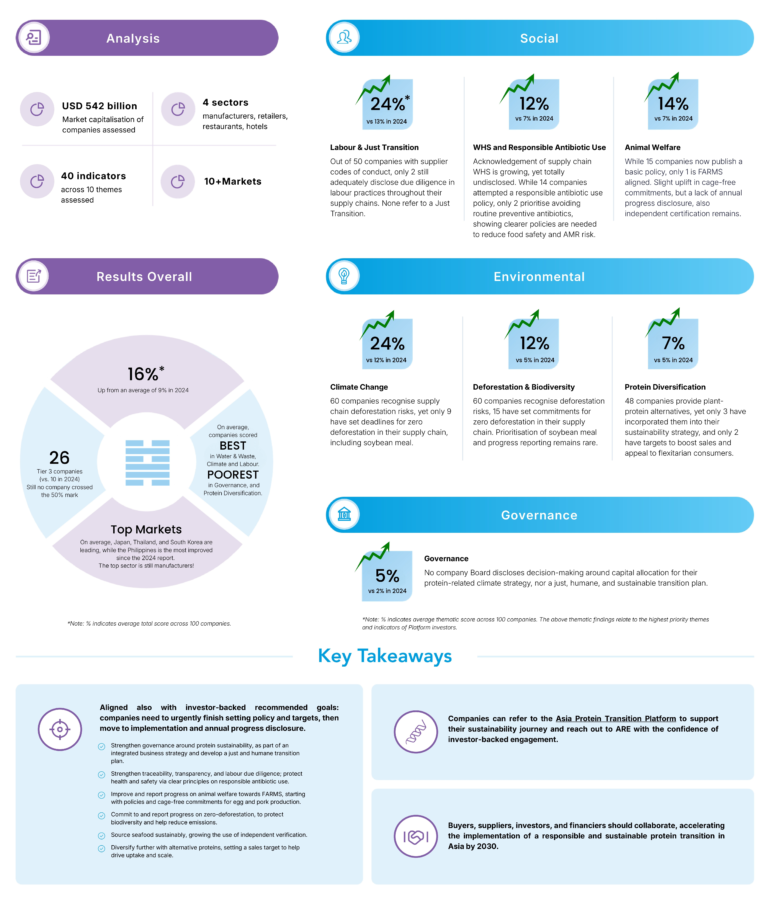
- Average scores rose from ~9% in 2024 to ~16% in 2026, with around 86% of comparable companies improving year-on-year.
- No company reached the top two performance tiers. Gaps in credible implementation — progress monitoring, verification, and accountability — remain a sticking point despite some detailed policies and commitments.
- The leading Tier 3 group more than doubled, growing from 10 to 26 companies, while the lagging Tier 6 group halved from 46 to 21.
- Governance (in relation to protein sustainability) remained the lowest-scoring metric, averaging only ~4.5%. Most companies scored zero, indicating that protein sustainability is not yet embedded at the board level.
- Traceability is advancing, but coverage remains partial. More companies describe digital traceability tools and sourcing standards, yet far fewer quantify coverage across their full protein supply chains.
- Climate Change and Labour improved fastest, reflecting wider uptake of disclosure norms, emerging mandatory Scope 3 reporting, and labour supply chain due diligence expectations.
- Deforestation and Biodiversity disclosures remain thin. Companies increasingly acknowledge nature-related risk, but time-bound commitments and verified deforestation-free sourcing remain limited.
- Protein Diversification averaged ~7.4%, suggesting most companies have yet to set a target for plant-based sourcing, as part of a strategy for a climate-safe, just, and humane protein transition.
- Animal Welfare disclosure is growing but rarely quantified. Public policy disclosure is growing, but cage-free commitments and annual progress remain nascent.
- Overall, policies and narrative disclosure are advancing faster than quantified coverage, targets, and outcomes — a pattern consistent across both editions of the report, but especially critical as the transition from policy to practice becomes ever more urgent as 2030 approaches.
About the APB100 Benchmark
The APB100 uses a structured set of investor-backed indicators spanning 10 themes: governance, traceability, labour and just transition, worker health and safety, including antimicrobial resistance (AMR), animal welfare, climate change, deforestation and biodiversity, seafood, water and waste, and protein diversification / plant-proteins.
In addition to the 100 Asian companies, two leading international companies with extensive Asian supply chain operations were assessed using the same framework. Both ranked in Tier 2, illustrating what stronger performance looks like when companies combine clearer policies with better practices and consistent annual disclosure.
The APB100 is produced by ARE, an independent, non-profit engagement organisation working with institutional investors to drive sustainable business practices across Asia. The 2026 report was authored by Dave Luo and Kate Blaszak, with additional research by Sheetal Rana and Yining Zhao.
Recommendations
The APB100 findings point to four priorities for Asia’s protein buyers:
- Embed protein sustainability into governance and business strategies. Clear board oversight, capital allocation, and cross-functional coordination are prerequisites for credible execution on climate, deforestation, labour, animal welfare, water, waste, and antimicrobial stewardship.
- Close the gap between policies and proof. Buyers should invest in traceability systems, strengthen supplier due diligence across labour and nature risks, and expand third-party verification based on supply chain risk profile.
- Address persistent blind spots in food safety. Antimicrobial resistance and low animal welfare standards are linked risks. Companies need clear supplier requirements, cage-free and antibiotic stewardship targets, and transparent reporting, particularly in livestock and aquaculture supply chains.
- Integrate protein diversification into climate and nature strategies. Buyers should set measurable targets for expanding plant-based proteins, drive demand, and report progress annually, recognising that menu and sourcing shifts are increasingly important levers for risk management and climate resilience.
With less than five years until key 2030 targets, the APB100 provides a clear, data-driven view of where progress is emerging and where more leadership is still required.
Download the APB100 2026 report to explore company scorecards, regional ESG trends, protein diversification strategies, and pathways for accelerated action across Asia’s food sector.


