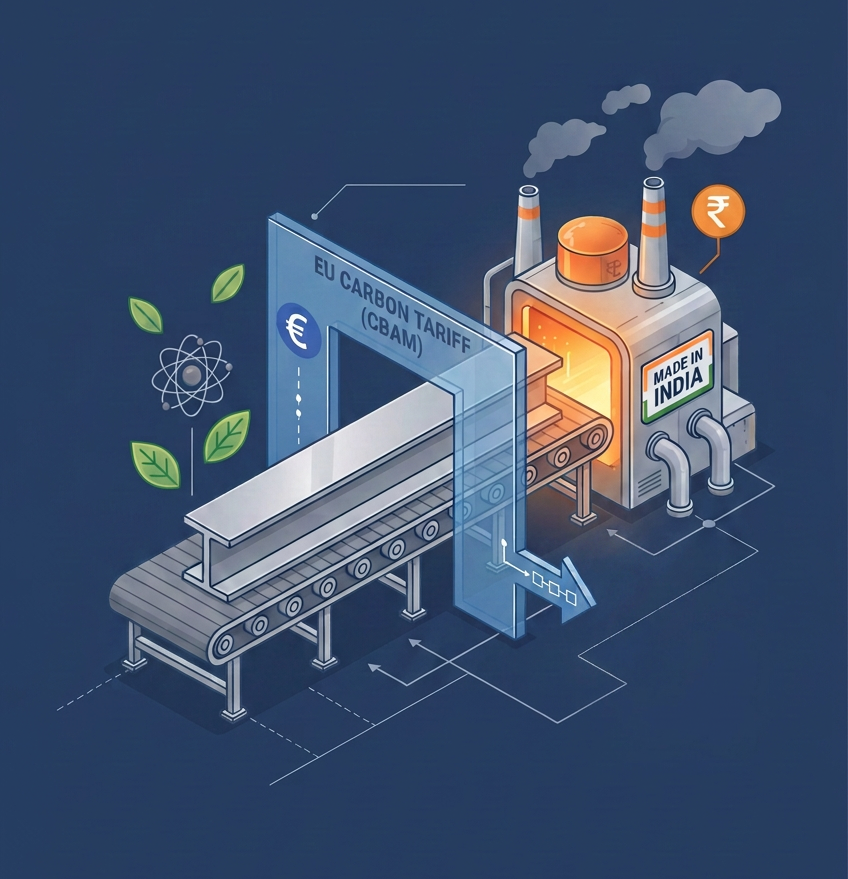
The European Union’s Carbon Border Adjustment Mechanism (CBAM) is reshaping the economics of the global steel trade. For India, where iron and steel account for around 90% of CBAM-covered exports to the EU, the implications are concentrated and material.
The CBAM Test: Indian Steel’s Future in Europe is a new Insights paper from Asia Research & Engagement (ARE) examining how CBAM will affect Indian steel producers between 2026 and 2034, when the EU’s free ETS allowances are fully phased out. It assesses sector-wide exposure, company-level impact on producers like JSW Steel, Tata Steel India, SAIL, and JSPL, and the policy response India will need to remain competitive.
Key Findings
- India’s CBAM exposure is small in aggregate but heavily concentrated. Only 1.6% of India’s total trade is at risk, but 90% of that exposure comes from iron and steel. EU-bound iron and steel exports reached USD 4.2 billion in FY2025, around two-thirds of industry shipments.
- Indian steel is carbon-intensive relative to the EU benchmark. Around 70% of Indian steel production still uses the emissions-intensive BF-BOF route, generating 2.5 tCO₂ per tonne against the EU average of 1.8 tCO₂. India also has no domestic carbon price, meaning zero offsetting credit against CBAM charges.
- The cost impact will escalate sharply over time. Net CBAM costs on Indian steel are projected to rise from about EUR3-4 per tonne in 2026 to EUR170-200 per tonne by 2034. Indian exporters may need to cut prices by 15 to 22% to absorb the full burden, with EU steel imports from India potentially declining around 24% cumulatively by 2034.
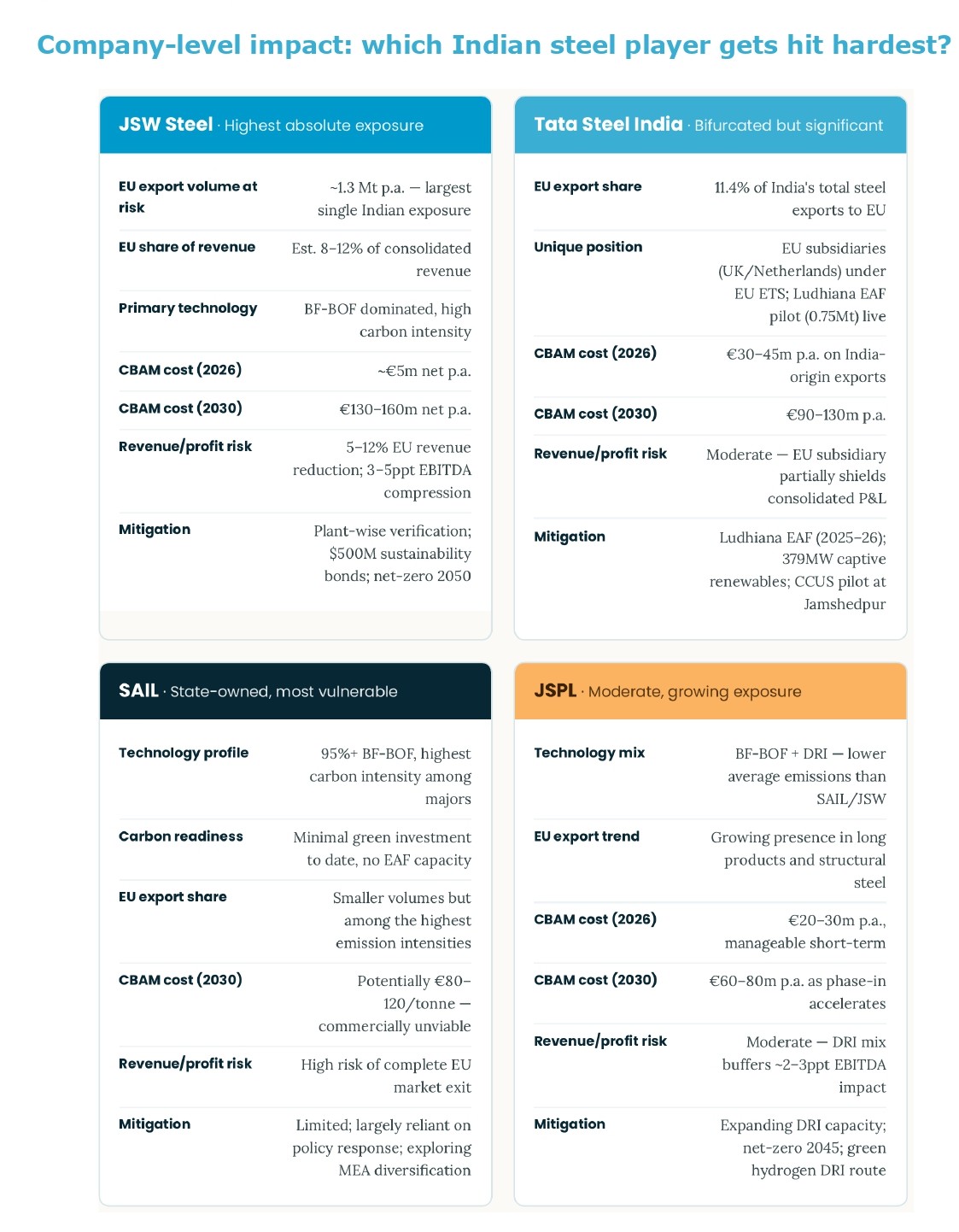
- Exposure varies significantly across producers. JSW Steel carries the highest absolute exposure at around 1.3 Mt per annum of EU-bound steel and an estimated EUR130-160 million CBAM cost by 2030. Tata Steel India faces EUR90-130 million by 2030. SAIL, with over 95% BF-BOF production, faces costs of EUR80-120 per tonne that may prove commercially unviable. JSPL faces a more moderate EUR60-80 million by 2030.
Recommendations
The paper argues that India should treat CBAM as an industrial policy issue, not only a trade disruption issue. A narrow legal challenge at the WTO may have political value, but it will not remove the underlying market signal as carbon-differentiated procurement and financing continue to spread globally.
A strong policy response would prioritise:
- Building a national industrial MRV architecture.
- Accelerating the domestic carbon market in a sector-sensitive way.
- Supporting low-emissions steel investment.
- Protecting smaller firms during the transition.
- Linking trade negotiations to industrial transition.
Firms with stronger emissions measurement, cleaner production routes, renewable power access, and clearer decarbonisation plans will adapt faster. Those that depend on blast-furnace production, weak MRV systems, and delayed capital investment will face greater margin pressure and higher risk of market loss.
About the Insights Paper
The CBAM Test: Indian Steel’s Future in Europe is part of ARE’s Insights series, published in September 2026. The paper draws on peer-reviewed studies, policy papers, industry reports, and official publications, and incorporates the simplifications introduced under the EU’s October 2025 Omnibus package.
The paper is authored by Arun Kumar, Strategic Advisor – Power Markets & Technology Innovation, and Arshiya Bhutani, Manager – Engagement and Research India, at ARE.
It complements ARE’s earlier report Forging Ahead: Pathways to Green Steel for India (May 2026), which sets out the domestic decarbonisation pathways available to India’s steel majors.
Download the full Insights paper to explore the CBAM phase-in timeline, cost escalation modelling, company-level exposure analysis, and policy recommendations for India.


