
Cage-free and climate: do they belong on the same transition pathway?
As emissions, animal welfare, and cage-free commitments increasingly feature in sustainability disclosure frameworks, companies face growing expectations to demonstrate progress across both climate and animal welfare objectives.
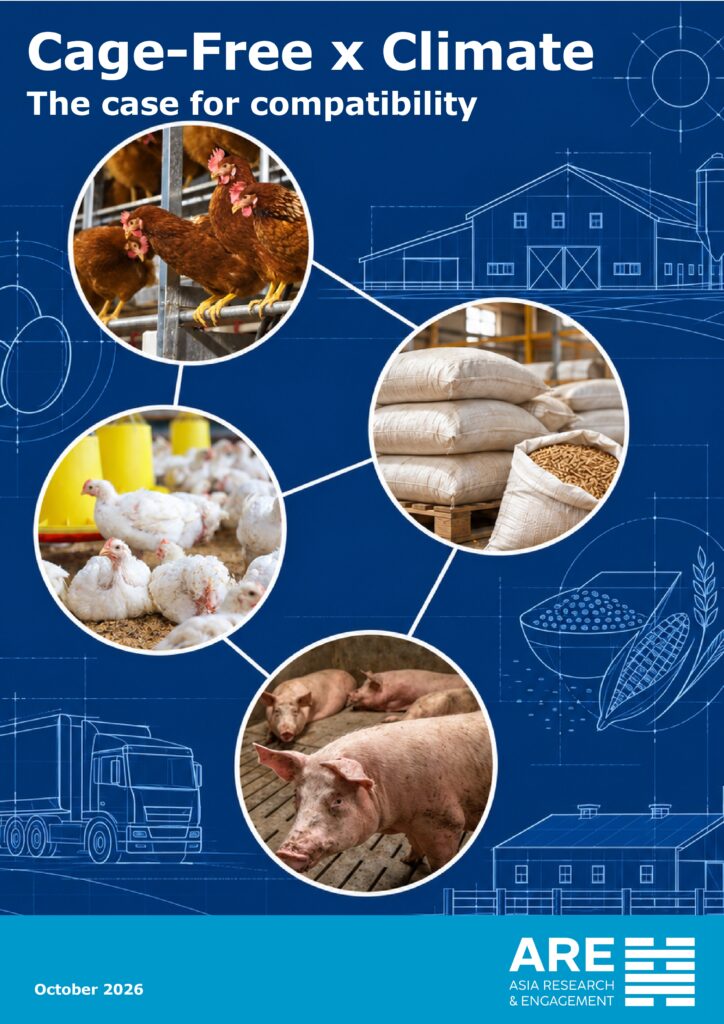
Cage-Free x Climate: The Case for Compatibility, a research series by Asia Research & Engagement (ARE), examines whether cage-free housing systems for broilers, laying hens, and gestating sows can deliver higher animal welfare standards without compromising climate performance.
The research finds that animal welfare improvements and climate action can be compatible. In the Asian context, producers can move to cage-free housing and improve climate performance at the same time. The climate result is decided by where feed comes from, how manure and litter are handled, and by day-to-day husbandry, from mortality and culling to laying rate.
The research is published in four parts. Part A sets out the framing and shared findings, and Parts B1 to B3 cover gestating sows, broilers and laying hens.
Why This Matters
The research highlights three important findings:
- Feed sourcing outweighs housing-related emissions differences. 60–84% of total greenhouse gas emissions are attributable to feed production. Avoiding deforestation-linked soy delivers climate gains larger than any difference between housing systems, particularly for Asian producers dependent on imported soy with high deforestation risk.
- The recommended systems are indoor cage-free systems suited to Asian conditions: group housing with electronic sow feeders for sows, cage-free floor systems with moderately slower-growing breeds for broilers, and single-tier or multitier systems for laying hens. The climate result depends on how they are run, not on the housing label.
- The European evidence does not transfer directly to Asia. Studies that find large footprints for higher-welfare production typically model free-range and organic systems; not the indoor cage-free systems this report recommends. In cold-climate studies of broilers and sows, part of the penalty comes from heating low-density housing; in tropical Asia that penalty largely disappears. Heat stress, worst in caged and high-density systems, becomes the main production risk.
The findings demonstrate that higher-welfare production and climate action are compatible.
Four levers that decide the climate result
Across the three industries, the research identifies four management priorities that have a greater influence on emissions than the housing system alone.
- Feed sourcing – The most influential factor in climate performance. Avoiding deforestation-linked feed, reducing soy dependence and improving feed efficiency can deliver substantial emissions reductions.
- Manure and litter management – Improved moisture control, shorter storage periods, and downstream abatement can reduce greenhouse gas and ammonia emissions, regardless of the housing system.
- Reproductive and production performance – Stable grouping, appropriate genetics, and active management of mortality and culling are where cage-free systems earn their climate offset.
- Housing-energy design – Efficient ventilation, heating, and cooling are important in determining whether higher-welfare housing infrastructure increases or contains energy-related emissions.
Together, these measures offer practical approaches for improving animal welfare and climate performance at the same time.
Recommendations: Pathways to Climate-Efficient Cage-Free Production
The series provides production-specific recommendations for transitioning towards higher-welfare systems while managing emissions and operational costs.
Gestating Sows: Group Housing and Precision Feeding
The research recommends full group housing with electronic sow feeders, enabling feed to be tailored to each sow’s nutritional requirements.
By reducing dietary crude protein and soy inclusion, this approach can lower nitrogen excretion by up to 17% and phosphorus excretion by up to 15%, reducing emissions associated with manure management.
Optimised precision feeding can also reduce system-wide greenhouse gas emissions by up to 6%.
With feed accounting for 70–77% of emissions in import-reliant Asian pig production systems, precision feeding is an important component of climate-efficient group housing.
Broilers: Cage-Free Floor Systems
For broilers, the series recommends cage-free floor systems with moderately slower-growing birds, reduced stocking densities, environmental enrichment and appropriate lighting.
While not representing the highest-welfare option available, this approach captures most of the animal welfare gains at a moderate climate cost.
The recommended system can also reduce antibiotic use, mortality, and leg problems, while supporting food safety in hot climates.
Laying Hens: Cage-Free Single-Tier and Multitier Systems
For laying hens, the research recommends cage-free, barn-raised single-tier or multitier aviary systems, which enable natural behaviours including nesting, perching, dustbathing, foraging, and freedom of movement.
Each system offers distinct advantages:
- Single-tier systems are simpler to manage and carry a lower risk of keel fractures.
- Multitier aviaries enable a fuller range of natural behaviours and accommodate more birds per square metre of floor space.
Producers should select the most appropriate system based on management capabilities, local conditions, expected demand and economic considerations.
About the Report
Cage-Free x Climate: The Case for Compatibility is a research series by Asia Research & Engagement (ARE), authored by Dave Luo and Fadhilah Abdullah. The series addresses the common assumption that higher-welfare systems carry a climate cost the industry cannot afford, and finds it substantially overstated.
Covering broilers, laying hens and gestating sows, the series examines the relationship between animal welfare and greenhouse gas emissions, identifies where welfare and climate align, conflict or depend on management and presents practical recommendations for climate-efficient cage-free farming.
The research provides companies, investors and other stakeholders with evidence to inform assessments of animal welfare commitments, production practices and climate performance across Asia’s agri-food industry.
Download the report series to explore the findings, production-specific recommendations and practical pathways for improving animal welfare while managing greenhouse gas emissions.


