
India’s protein system is at a turning point. As demand grows alongside rising incomes and shifting diets, how the country produces, sources, and diversifies its protein will shape food security, natural resources, producer livelihoods, and climate outcomes for decades to come.
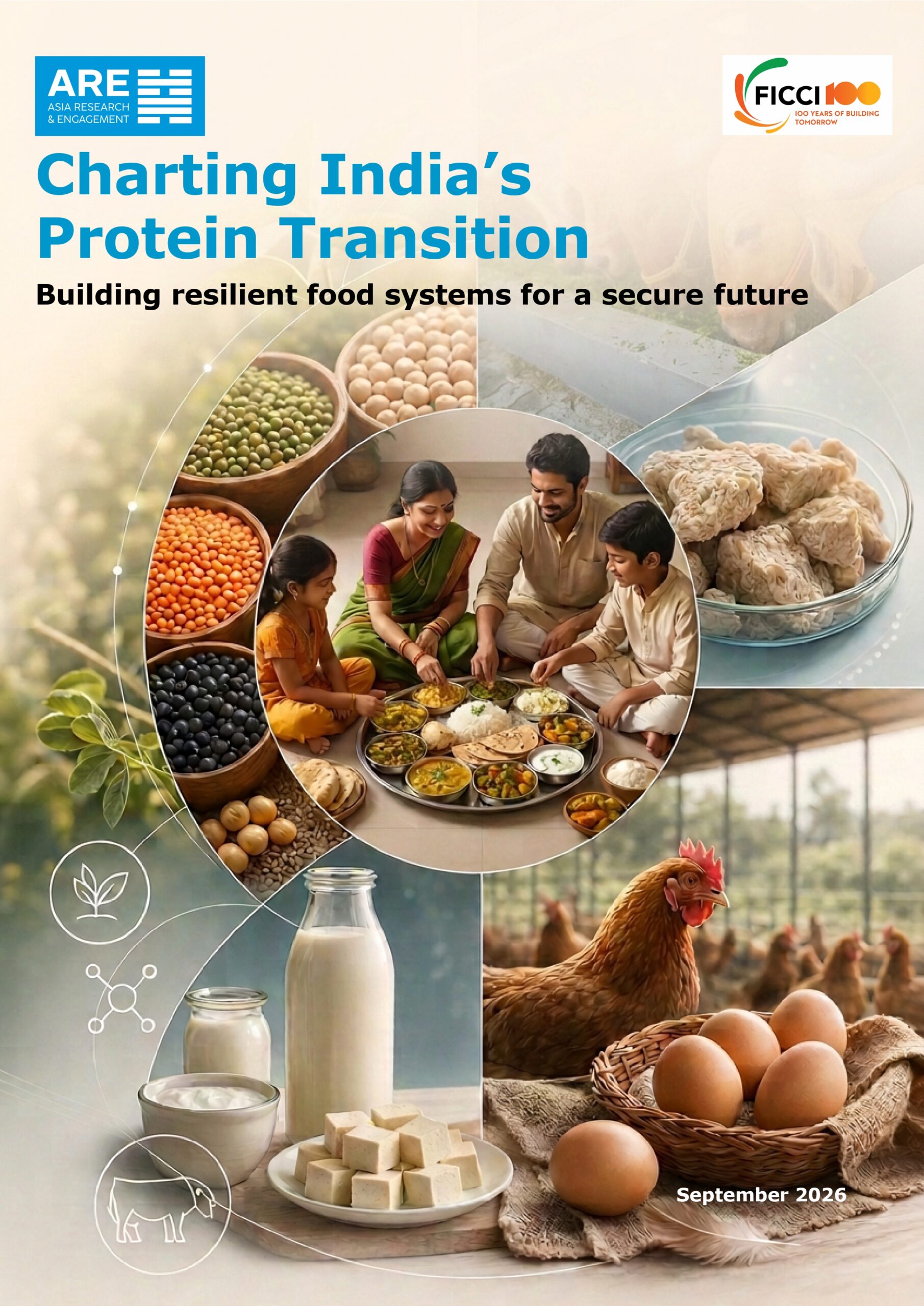
Charting India’s Protein Transition is a new joint report from Asia Research & Engagement (ARE) and the Federation of Indian Chambers of Commerce and Industry (FICCI). The report models how India can meet a projected surge in per-capita protein consumption by 2070 while reducing emissions, strengthening domestic value chains, and supporting producer livelihoods.
Why This Matters
India is set to become one of the most significant drivers of global food demand over the coming decades, with material implications for climate, land use, and investment flows.
- India’s annual average per-capita protein consumption is projected to more than triple by 2070, rising from 9.5kg in 2025 to 30kg.
- India and Southeast Asia are forecast to account for 31% of additional global agricultural and fisheries consumption by 2033.
- Under a business-as-usual pathway, annual protein-related emissions could reach 1.92 GtCO₂e by 2070, almost eight times the estimated climate-safe threshold of 0.25 GtCO₂e.
- Cumulative excess emissions could exceed 44 GtCO₂e between 2025 and 2070 if the current trajectory continues, equivalent to more than three-quarters of current annual global greenhouse-gas emissions.
The report finds that this trajectory can be changed. Its modelling identifies pathways that significantly reduce emissions while meeting rising demand, supporting producer livelihoods, and creating new investment opportunities.
Key Findings
The report identifies four priorities for India’s protein transition.
- Production improvements will be critical, but not sufficient. Measures across methane, feed, manure, deforestation, energy, and food loss and waste could cut annual protein-related emissions to 0.73 GtCO₂e by 2070, still 2.9 times the climate-safe threshold. Greater protein diversification could reduce this to 0.50 GtCO₂e, while an integrated pathway combining both could bring emissions down to 0.30 GtCO₂e.
- Pulses present a major domestic innovation and growth opportunity. Pulse-derived protein consumption is projected to rise from 3.5 million tonnes in 2025 to 9.3 million tonnes by 2070, making pulses India’s second-largest protein category after dairy. India currently imports almost 90% of its processed plant protein isolates, creating further opportunity to expand domestic processing and higher-value manufacturing.
- Existing supply constraints could intensify as demand grows. The report highlights estimated shortfalls of 35.6% in green fodder, 10.5% in dry fodder, and 44% in concentrate feed ingredients, with climate pressures likely adding further volatility to feed availability and production costs.
- Producers will be central to the transition. Smallholders account for around 72% of India’s milk production, while poultry and fisheries rely heavily on contract growers, fragmented producers, and smaller businesses. Targeted finance, procurement reform, technical assistance, and producer consultation will be important in supporting their participation in the transition.
About the Report
Charting India’s Protein Transition is a joint report by Asia Research & Engagement (ARE) and the Federation of Indian Chambers of Commerce and Industry (FICCI), authored by ARE’s Rituj Sahu and Kate Blaszak, with research by Dave Luo and Sheetal Rana and contributions from Hemant Seth and the FICCI team.
The report was launched on 8 September 2026 at the FICCI Symposium, Protein for India: Nutrition, Business, Sustainability, and Policy Perspective, at FICCI Federation House in New Delhi.
Recommendations
The report identifies six priority actions to support a more resilient, secure and climate-aligned protein transition in India:
- Prioritise high-impact production-side mitigation, including methane reduction, more sustainable feed systems, and measures to reduce deforestation and food loss and waste.
- Build a more resilient and responsible dairy system, with greater attention to climate resilience, animal health and welfare, resource efficiency, and producer support.
- Scale pulses and traditional plant proteins, strengthening domestic production, processing capacity, and innovation in ingredients and higher-value products.
- Build pathways for emerging proteins, supporting R&D, manufacturing infrastructure, and the development of plant-based, fermentation-derived, and cultivated proteins.
- Strengthen transparency, traceability and risk management across protein value chains, including animal welfare, antimicrobial stewardship, and climate- and nature-related risks.
- Mobilise capital and partnerships for the transition, directing finance towards more resilient supply chains, infrastructure, innovation, and producer transition.
Across these priorities, the report emphasises that transition costs cannot simply be pushed upstream to smallholders, contract growers, and MSMEs. Finance, technical support, procurement practices, and producer participation will be critical to ensuring a resilient and inclusive transition.
Download Charting India’s Protein Transition to explore the full modelling, pathway analysis, and detailed recommendations for policymakers, investors, and food and agricultural businesses.

